An Everett workplace injury caused by someone other than your employer is a third-party claim, not just an L&I claim. Washington law gives you that second claim on top of your benefits, and you get three years to bring it. You can also lose that right in 60 days, because of a form L&I mails you. That form ends more of these cases than any defense lawyer ever will. This guide covers who counts as a third party in Everett. It covers the two deadlines, what you keep, and the four Supreme Court decisions that decide whether you win.
Written by Courtney Hansen, a Washington personal injury attorney (WSBA #43872). She has litigated injury cases for more than 15 years, including six years as trial counsel and Associate General Counsel for a major insurance carrier.
Your L&I Claim Is Not the Only Claim You Have
The Short Version
- You can do both. An L&I claim and a third-party lawsuit run side by side. RCW 51.24.040 guarantees your benefits are untouched by either the election or the recovery.
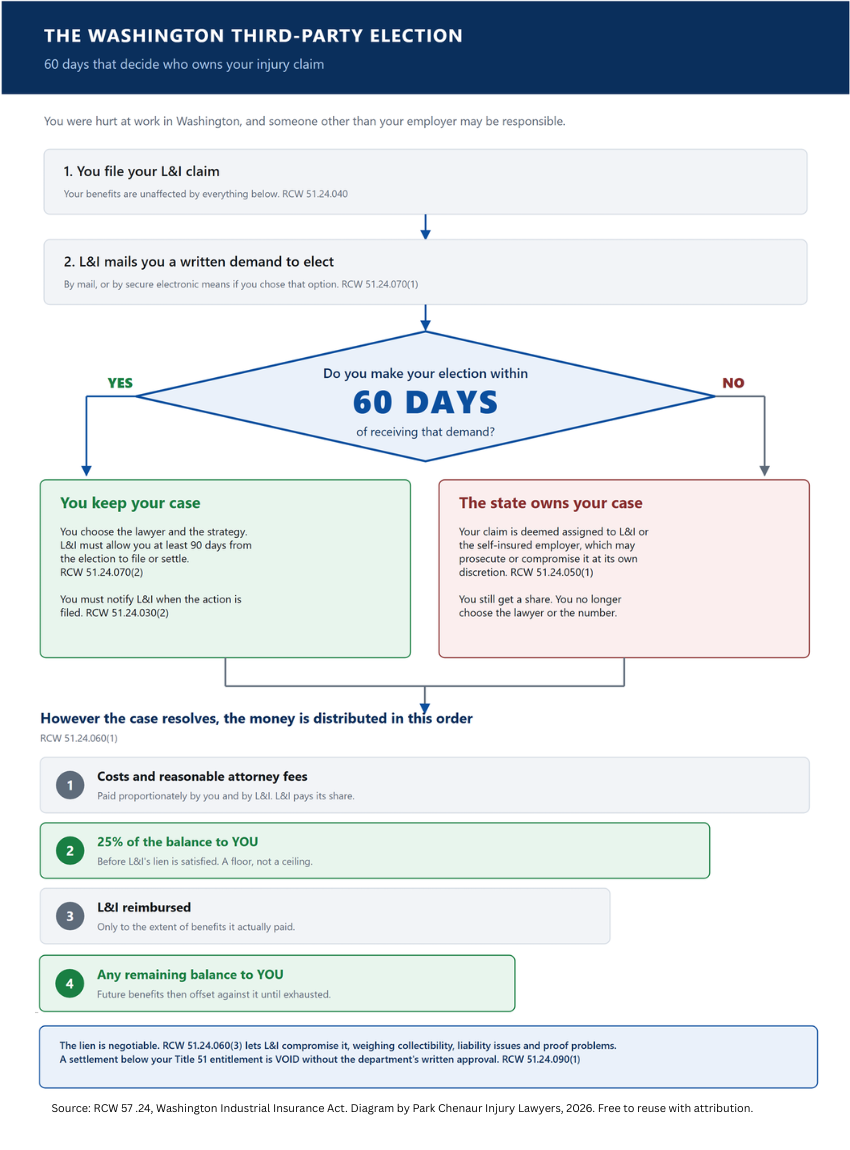
- You have 60 days to elect. Under RCW 51.24.070(2), missing L&I's written demand by 60 days transfers your case to the state, with years still left on the statute of limitations.
- L&I does not take everything. RCW 51.24.060 pays fees first, hands you 25 percent of the balance before L&I's lien, then repays L&I only for benefits it actually covered.
- Your employer's fault never reduces your recovery. RCW 4.22.070(1) keeps Title 51-immune employers off the verdict form entirely.
- Everett has more of these claims than almost anywhere in Washington. Three in ten Snohomish County jobs sit in the multi-employer industries where third parties exist, against fewer than two in ten statewide.
The Envelope From L&I That Decides Whether You Keep Your Case
File a Report of Accident. If anything in it suggests someone outside your workplace caused the injury, L&I sends you a packet. It is titled "Injured by a third party? You have legal options." There is a form inside. The cover tells you to complete it promptly.
Here is what the pamphlet says happens if you do not:
You lose these important rights if you do not return this form to us. If you do not complete and return the enclosed form, the right to take legal action may be automatically assigned to the Department of Labor & Industries. In that case, you would no longer have the right to recover personal injury damages yourself or with your attorney, but you will receive a portion of any recovery made by L&I.
Source: Washington State Department of Labor & Industries, Injured by a third party? You have legal options, publication F249-008-000
That is not a law firm scaring you. That is the agency describing its own process.
The statute behind it is RCW 51.24.070. Subsection (2) sets the clock: unless an election is made within 60 days of receipt of the demand, and unless an action is filed or settled in the time the department grants, the injured worker "is deemed to have assigned the action to the department or self-insurer." RCW 51.24.050 spells out the result. An election not to proceed "operates as an assignment of the cause of action to the department or self-insurer, which may prosecute or compromise the action in its discretion."
Read that again. If the clock runs out, the claim does not disappear. It changes owners. L&I decides whether to pursue it, how hard, and what to settle it for. You get a share of whatever L&I brings in. You no longer choose the lawyer, the strategy, or the number.
There is a partial escape hatch. RCW 51.24.070(4) allows a right of reelection, but only "at the discretion of the department or self-insurer," and only if you reimburse the litigation expenses L&I has already spent. Discretionary is not the same as available.
One wrinkle matters in 2026 and nobody else is flagging it yet. The legislature amended RCW 51.24.070(1) this year. The department can now serve that demand by secure electronic means, if the worker picks that option, alongside regular mail. That deadline used to land as an envelope on a kitchen counter. Now it can land in an inbox, next to everything else, while you recover from surgery.
If you got mail or email from L&I about a third party, do not set it aside. That is the whole ballgame.
Why Everett Workers Run Into This More Than Most Washingtonians
Third-party claims come from workplaces where more than one company shares the same space. A general contractor and five subcontractors on one site. A property owner, a tenant, and a maintenance vendor. A shipper, a carrier, and a warehouse operator. A machine built by one company, installed by a second, serviced by a third.
Snohomish County is unusually full of exactly that kind of workplace.
Federal employment data for the fourth quarter of 2025 shows Snohomish County with 300,572 covered jobs. Of those, 55,800 were in manufacturing, 23,340 in construction, and 11,060 in transportation and warehousing. That is 90,200 jobs, almost exactly 30 percent of everyone working in the county. In those three sectors, multi-employer worksites are the norm, not the exception.
Statewide, those same three sectors account for 18.7 percent of covered employment. Manufacturing alone runs 18.6 percent in Snohomish County against 7.8 percent across Washington, roughly two and a half times the state rate. Those figures come from the U.S. Bureau of Labor Statistics Quarterly Census of Employment and Wages for 2025 Q4. We calculated the shares from the published county and state totals.
Three out of every ten jobs here, against fewer than two out of every ten statewide.
That gap is not trivia. The average injured Everett worker is far more likely than the average injured Washington worker to have been hurt somewhere their employer did not control. It also means the standard jobsite advice fails here more often than almost anywhere in Washington. You are on L&I, so nothing else exists. That advice misses real claims.
What the Exclusive Remedy Rule Actually Bars, and What It Does Not
Washington's Industrial Insurance Act was a trade. Workers got a no-fault system that pays no matter who caused the injury. Employers got immunity from suits by their own workers. RCW 51.04.010 states the employer's side of the bargain bluntly: "all civil actions and civil causes of action for such personal injuries and all jurisdiction of the courts of the state over such causes are hereby abolished, except as in this title provided."
The bargain covers your employer and your coworkers. It covers nobody else.
RCW 51.24.030(1) says so directly: "If a third person, not in a worker's same employ, is or may become liable to pay damages on account of a worker's injury for which benefits and compensation are provided under this title, the injured worker or beneficiary may elect to seek damages from the third person."
The difference between the two claims is not a detail. It is most of the money.
| L&I claim | Third-party claim | |
| Who you claim against | The state fund or a self-insured employer | The company that actually caused the injury |
| Do you prove fault? | No. It is no-fault | Yes. You prove negligence |
| Medical treatment | Covered | Recoverable, including future care |
| Lost wages | A statutory portion only | Full past and future lost earnings and earning capacity |
| Pain and suffering | Not available | Recoverable |
| Loss of consortium for your spouse | Not available | Recoverable |
| Disfigurement and loss of enjoyment of life | Not available | Recoverable |
| Deadline | Report the injury per L&I rules | Three years. RCW 4.16.080(2) |
| Can you have both? | Yes | Yes. RCW 51.24.040 |
An L&I claim pays medical treatment and a portion of your lost wages. It pays nothing for pain. Nothing for the way a spinal cord injury reshapes the next thirty years. Nothing to your spouse. Nothing beyond a statutory fraction of what you earned. A third-party claim reaches all of it. That is why the election form matters, and it is why nobody should sign it without understanding what the second column is worth. If you work through a temp or staffing agency, identifying your actual employer is its own threshold question.
Who Counts as a Third Party in an Everett Workplace Injury Claim
L&I's own pamphlet gives the examples, and they are broader than most injured workers assume:
- "The driver of the car that hit you."
- "A manufacturer of the defective product that injured you."
- "A property owner who failed to properly maintain the building where you were working when you were hurt."
- "The owner of an animal that bit you."
- "A worksite general contractor if you were employed by a subcontractor."
In our experience those five are not equally valuable. Rank them by how often they hold real insurance and real responsibility on an Everett industrial file. The general contractor and the site owner come first. Equipment manufacturers come second. The at-fault driver comes third, even though that claim is the most common by volume.
The general contractor on your jobsite
Say you work for a subcontractor and get hurt on a site run by a general contractor. Washington puts the safety obligation on the general. It does so as a matter of law, not as something a jury has to be talked into.
That rule comes from Stute v. P.B.M.C., Inc., 114 Wn.2d 454, 788 P.2d 545 (1990). Andre Stute worked for S&S Gutters, a subcontractor installing gutters on a condominium project. The roof was slick from recent rain. There was no scaffolding and no fall protection. He slipped, fell three stories, and fractured three vertebrae and a bone in his foot. The general contractor knew subcontractor employees were up there without safety devices.
The trial court threw the case out because Stute was not the general's employee. The Washington Supreme Court reversed:
To further the purposes of WISHA to assure safe and healthful working conditions for every person working in Washington, we hold the general contractor should bear the primary responsibility for compliance with safety regulations because the general contractor's innate supervisory authority constitutes sufficient control over the workplace.
Source: Justice Robert F. Utter, writing for a unanimous court in Stute v. P.B.M.C., Inc. (1990)
The court went further in the same opinion: "A general contractor's supervisory authority is per se control over the workplace, and the duty is placed upon the general contractor as a matter of law." That sentence is why these cases survive summary judgment when a comparable claim would fail in most states.
The statutory hook is the Washington Industrial Safety and Health Act. RCW 49.17.060 creates two different duties. Subsection (1) is a general duty to furnish "each of his or her employees" a workplace free of recognized hazards, and it protects only that employer's own people. Subsection (2) is a specific duty to comply with the safety regulations, and it protects everyone the violation can hurt. The second duty is what reaches across company lines to you. Scaffolding and structural collapse cases live almost entirely in that second subsection.
The owner of the site you were working on
A site owner is not automatically on the hook. In Kamla v. Space Needle Corp., 147 Wn.2d 114, 52 P.3d 472 (2002), the court held that jobsite owners are not automatically liable for safety-regulation violations. They owe the duty "only if they retain control over the manner in which contractors complete their work."
Retained control is a question of fact, and owners routinely have more of it than they admit. In Afoa v. Port of Seattle, 176 Wn.2d 460, 296 P.3d 800 (2013), Brandon Afoa worked at Sea-Tac for a ground-services company called EAGLE. He drove a tug, the vehicle that pushes aircraft back from a gate. He lost control and hit a K-loader, a large piece of loading equipment. It fell on him.
The Port did not employ Afoa. It did not even contract with EAGLE, which merely held a license to operate on the property. The Port argued that made Afoa a stranger to it. The court disagreed on all three of Afoa's theories: business invitee premises liability, the WISHA specific duty, and the common-work-area duty of a general contractor.
The Port is the only entity with sufficient supervisory and coordinating authority to ensure safety in this complex, multiemployer work site, and if the Port does not keep Sea-Tac Airport safe for workers, it is difficult to imagine who will
Source: Justice Charles K. Wiggins, writing for the court in Afoa v. Port of Seattle (2013)
The counterweight arrived a decade later, and you should know about it because the defense will lead with it. In Eylander v. Prologis Targeted U.S. Logistics Fund, 2 Wn.3d 401, 539 P.3d 376 (2023), a roofing contractor's employee fell through a warehouse skylight and died. The court held that a landowner may hand a qualified independent contractor its duty to protect invitees from known or obvious dangers. Prologis met that duty by hiring an experienced roofing company and requiring a site-specific safety plan.
Read those three together and the practical lesson is clear. Whether the owner stays in the case turns on documents and conduct, not labels. Contracts, site rules, safety plans, inspection rights, who ran the safety meetings, who could stop work. Those records exist on the day you are hurt. They do not stay complete forever.
The manufacturer, installer, or service company behind the equipment
Say a press, lift, hoist, conveyor, ladder, or vehicle failed. Every company that designed it, built it, sold it, installed it, or serviced it under contract is a third party. Product liability claims are their own body of law. They turn on physical evidence. The machine, the missing guard, the maintenance log, the service tickets.
Design professionals are a narrower target. RCW 51.24.035 gives architects, engineers, land surveyors, and landscape architects immunity from an injured worker's claim on a construction project. Two things break that immunity. A mutually negotiated contract in which the professional took on safety responsibility, or actual control over the part of the site where you were hurt. That immunity has an important carve-out: it "does not apply to the negligent preparation of design plans and specifications."
The driver who hit you while you were on the clock
If you were driving for work and another motorist caused the collision, that motorist is a third party. This is the most common third-party claim in Washington by volume. Delivery routes, service calls, hauling, and travel between job sites all produce them. Commercial vehicle cases frequently add a carrier and a broker on top of the driver.
One technical point here saves real money. Under RCW 51.24.030(4), underinsured motorist money falls under this chapter, and so under L&I's lien, only if your employer owns the policy. Collecting under your own personal auto policy instead of your employer's commercial policy? Then that recovery sits outside the lien structure entirely.
Where These Claims Come From in Everett
The Paine Field aerospace and manufacturing corridor
Aerospace and advanced manufacturing cluster around Paine Field. That cluster drives Snohomish County's manufacturing share to more than double the state's. These are large facilities with layered contractor relationships. Plant owners and tenant manufacturers. Tooling and equipment vendors. Maintenance and janitorial contractors. Logistics companies hauling oversized components in and out. Get hurt while working for one of those companies because of another one, and you have a third-party claim. Who is responsible is very often not obvious from where you were standing.
The Port of Everett and the waterfront
Marine terminal and waterfront work stacks employers on top of each other by design. Terminal operator, stevedoring company, trucking company, rail carrier, equipment lessors, ship owners. Injuries here routinely involve equipment owned by one company, operated by a second, and maintained by a third, on property controlled by a fourth. Waterfront and maritime work can also trigger federal compensation schemes. Those sit alongside state industrial insurance, or replace it. Sort that out early, not late.
I-5, US 2, and the trestle
Everett sits at the junction of I-5 and US 2. The trestle funnels much of the county's commuting and freight traffic through one constrained corridor. Two overlapping claims come out of that corridor. One against the at-fault motorist. One against the contractor or agency running the work zone. Both hit workers driving for their jobs and the road crews inside it.
Evergreen Way, Broadway, and the Everett Mall Way commercial corridor
Retail, warehouse, restaurant, and service work along Everett's commercial corridors produces the property-owner category. Say you work for a tenant business and a condition the landlord controlled hurts you. Or a contractor working in the building does. Your claim runs against that landlord or contractor, not against your own employer. Wet-floor and slip and fall cases in a workplace are third-party cases far more often than workers realize.
Does This Cost Me My L&I Benefits?
No. RCW 51.24.040 is one sentence and it is unambiguous: "The injured worker or beneficiary shall be entitled to the full compensation and benefits provided by this title regardless of any election or recovery made under this chapter."
L&I says the same thing in its pamphlet: "Your benefits continue during any legal action taken. If you are now receiving workers' compensation benefits and decide to pursue a third-party legal action, we would not stop or change your benefits until, or unless, you receive a financial recovery."
Electing to pursue a third party is not choosing between the two systems. It is adding a second one.
What Happens to the Money
This is where injured workers give up, usually because someone told them L&I takes everything. The statute says otherwise.
RCW 51.24.060(1) sets the order of distribution, and the sequence matters more than any single number:
- Costs and reasonable attorney fees come out first, paid proportionately by you and by L&I or the self-insurer. L&I pays its share in proportion to the benefits it is being reimbursed for. It does not ride free on the work that produced the recovery.
- You then collect 25 percent of the balance. The statute is explicit: "The injured worker or beneficiary shall be paid 25 percent of the balance of the award." That money reaches you before L&I's lien clears. It is a floor, not a ceiling.
- L&I or the self-insurer then recovers from what remains, but "only to the extent necessary to reimburse the department and/or self-insurer for benefits paid."
- You keep any remaining balance.
- Future benefits offset against that remaining balance until it runs out. Benefits then resume as though you had recovered nothing.
Two practitioner points change outcomes here, and neither appears on any competing page we reviewed.
First, the lien is negotiable. RCW 51.24.060(3) states that "the department or self-insurer has sole discretion to compromise the amount of its lien." The statute then names what L&I must weigh: how likely you are to collect, the liability and fact problems in the case, and the difficulty of proving it. A lien reduction is a live negotiation with published criteria. It frequently decides a large share of what you actually take home. How a claim is valued is only half the question. What you keep is the other half.
Second, you cannot settle around it. RCW 51.24.090(1) makes any compromise or settlement that "results in less than the entitlement under this title" void without the written approval of the department or self-insurer. Entitlement includes benefits already paid and benefits L&I estimates it will pay in future. Settling a third-party case without dealing with the lien is not a shortcut. It is a void settlement.
The Fault Rule That Works in Your Favor
Defendants in these cases reliably blame your employer's safety program. Not anything they did. In most states that argument works, because the jury assigns the employer a share of fault and the injured worker loses that share.
Washington took the tool away.
RCW 4.22.070(1) directs the trier of fact to determine the percentage of fault attributable to every entity that caused the damages, "except entities immune from liability to the claimant under Title 51 RCW." It then repeats the exclusion in the same subsection: the entities whose fault is determined "shall not include those entities immune from liability to the claimant under Title 51 RCW."
Your employer is immune under Title 51. Your employer therefore never appears on the verdict form. No jury parks a share of fault on a company you were never allowed to sue.
That is not a creative reading. The Supreme Court applied it directly in the second Afoa appeal:
Afoa's employer, EAGLE, was not "at fault" for purposes of RCW 4.22.070.
Source: Justice Steven C. González, writing for the court in Afoa v. Port of Seattle, 191 Wn.2d 110, 421 P.3d 903 (2018)
Your own comparative fault is a different matter. Under RCW 4.22.005, contributory fault "diminishes proportionately the amount awarded as compensatory damages" but "does not bar recovery." Being partly at fault reduces the number. It does not end the case.
That same Afoa litigation shows the real risk, and it deserves an honest telling. On remand the jury found $40 million in damages. It assigned 25.0 percent to the Port and 0.2 percent to Afoa. The remaining 74.8 percent went to four airlines that nobody had sued. Judgment against the Port came to $10 million. The exposure in a multi-employer case is not the negligent employer, who is off the form. It is the empty chair: the other companies on the site who are not defendants. Finding and suing every responsible entity early is the most consequential decision in a jobsite case. It is also the one lawyers most often get wrong.
The One Claim You Can Bring Against Your Own Employer
There is an exception to employer immunity. It is narrow, and any attorney who tells you it is easy is not being straight with you.
RCW 51.24.020 provides that if an injury results "from the deliberate intention of his or her employer to produce such injury," you may take L&I benefits and also sue the employer "as if this title had not been enacted."
For most of a century Washington courts read that to mean physical assault and nothing else. That changed in Birklid v. Boeing Co., 127 Wn.2d 853, 904 P.2d 278 (1995).
Boeing began using a new fiberglass cloth impregnated with phenol-formaldehyde resin at its Auburn fabrication facility. Before full production a Boeing general supervisor wrote that during preproduction "obnoxious odors were present," that employees complained of "dizziness, dryness in nose and throat, burning eyes, and upset stomach," and that "We anticipate this problem to increase as temperatures rise and production increases." He asked for better ventilation. Management denied it, writing that the odor level "does not warrant expenditure of funds at this time." Production began. Workers developed dermatitis, rashes, nausea, headaches, and dizziness. Some passed out at work.
We hold the phrase "deliberate intention" in RCW 51.24.020 means the employer had actual knowledge that an injury was certain to occur and willfully disregarded that knowledge.
Source: Justice Philip A. Talmadge, writing for the court in Birklid v. Boeing Co. (1995)
Understand what the court refused to do. It expressly declined to adopt the broader "substantial certainty" standard used in Michigan, North Carolina, South Dakota, and Louisiana, and declined Oregon's "conscious weighing" test. A known risk is not enough. A serious safety violation is not enough. Gross negligence is not enough. The employer must have known injury was certain and gone ahead anyway.
Birklid is a real door. It is a narrow one, and it opened on facts where the employer wrote its own prediction down in advance.
The Deadlines
There are two. They run at different speeds, and workers routinely watch the fast one expire while watching the slow one.
Three years to file suit. RCW 4.16.080(2) sets a three-year limit on personal injury actions. That is your outside deadline for the lawsuit.
Sixty days to elect. RCW 51.24.070(2) gives you 60 days from receipt of L&I's demand to elect. The department must then allow at least 90 days from that election to file or settle. Miss the 60 days and the claim transfers. Three years still sit on the statute of limitations, and you have no way to use them.
One more notice obligation gets missed even by workers who elect correctly. RCW 51.24.030(2) requires the plaintiff to give notice to the department or self-insurer when the action is filed. L&I or the self-insurer may then file a notice of statutory interest and intervene in your case to protect it.
What To Do in the First Two Weeks
Corporate evidence decides a jobsite case. It sits on a retention schedule, and the schedule is short.
- File the L&I claim. It is the foundation for everything else and it does not compete with the third-party claim.
- Open and answer the third-party form. Calendar 60 days from the day you received it. Do not let that date pass without a decision.
- Write down every company that was on the site. Not just your employer. The general contractor, the site owner, the other subs, delivery drivers, the equipment vendor, the maintenance company. Names on trucks, on hard hats, on badges.
- Photograph the scene, the equipment, and the guard or device that was missing, before anything is repaired, replaced, or cleaned up.
- Ask for the incident report and note who took it. Ask what video exists and who controls it. Site cameras routinely overwrite within weeks.
- Preserve the equipment. If a tool or machine failed, its physical condition is the case. It should not be repaired, scrapped, or returned to a vendor.
- Identify the safety documents early. The site safety plan, toolbox-talk sign-in sheets, inspection logs, the subcontract, and any WISHA citation issued after the incident.
- Say nothing recorded to another company's insurer. Your L&I claim is one conversation. A recorded statement to the general contractor's carrier is a different one, and what you say in it will be used.
How Park Chenaur Builds an Everett Third-Party Case
We start with the calendar. The 60-day election controls whether a case exists to build. Then we map the site. Every company that had a contract, a license, a crew, or a piece of equipment on it. Afoa teaches that the money often sits with parties who never employed anyone the worker met. We send preservation letters before video is overwritten and before failed equipment is scrapped. We pull the contracts and safety plans, because under Kamla and Eylander retained control is proven with documents or not at all. We coordinate with the L&I claim rather than around it. We also negotiate the lien under the RCW 51.24.060(3) criteria as its own piece of work. What you keep depends on that as much as on the gross number.
Were you hurt on the job in Everett? If anyone other than your employer or a coworker may share the blame, talk to an Everett workplace accident lawyer before your election deadline runs.
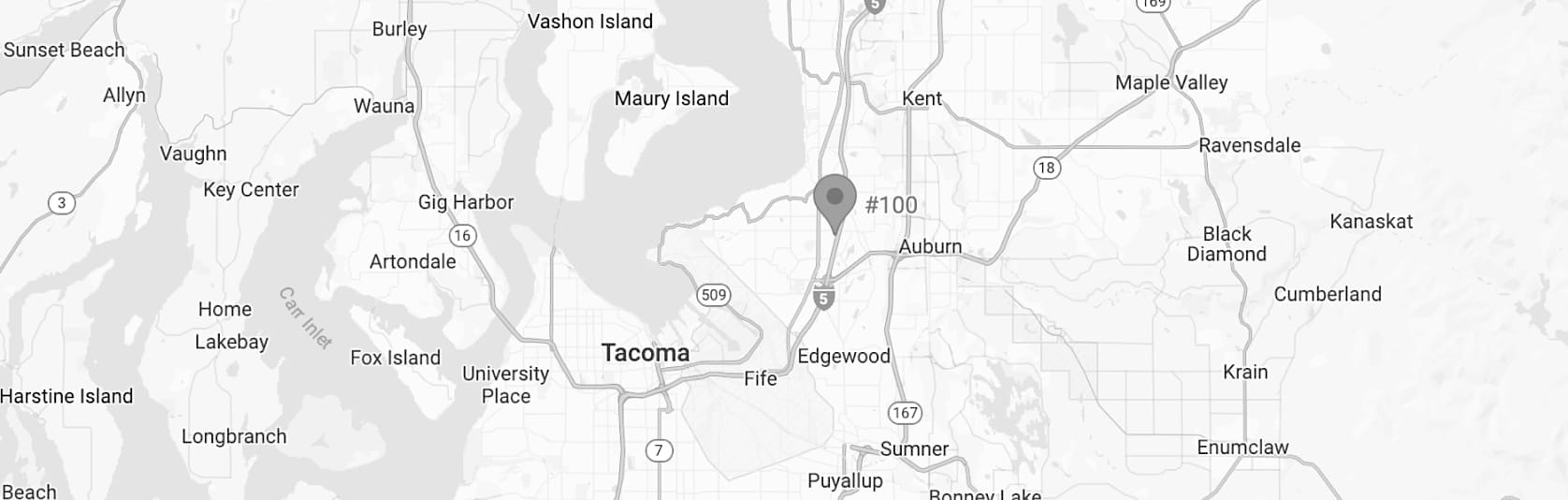
Schedule Your Free Consultation. Call Park Chenaur Injury Lawyers at 253-INJURED (253-766-5574), reach our Everett office at 425-399-5986, or contact us online. Consultations are free and we handle these cases on a contingency fee, which means no fee unless we recover for you.
Frequently Asked Questions
Can I sue if I am already receiving L&I benefits?
Yes, if someone other than your employer or a coworker caused the injury. RCW 51.24.030(1) lets you elect to seek damages from that third person. RCW 51.24.040 separately guarantees your full L&I benefits regardless of any election or recovery, so pursuing one does not cost you the other.
What is the 60-day L&I third-party deadline?
RCW 51.24.070(2) provides that unless you elect within 60 days of receiving L&I's written demand, you are deemed to have assigned the claim to the department or self-insured employer. The three-year statute of limitations runs separately and longer, but by then the claim may not be yours to file.
What happens if I miss the 60 days?
Under RCW 51.24.050(1), electing not to proceed assigns the cause of action to L&I. The department may then prosecute or compromise it at its own discretion. You still receive a share of any recovery, but you no longer control the case. Reelection is possible only at the department's discretion.
Can I sue my own employer for an unsafe workplace?
Almost never. RCW 51.04.010 abolishes those claims. The only exception is RCW 51.24.020, and under Birklid v. Boeing Co. it requires proof the employer "had actual knowledge that an injury was certain to occur and willfully disregarded that knowledge." A known hazard or safety violation alone does not meet that standard.
I work for a subcontractor. Can I sue the general contractor?
Often, yes. Stute v. P.B.M.C., Inc. holds that a general contractor's supervisory authority is control over the workplace as a matter of law. The duty to follow safety regulations runs to every worker on site.
L&I's own pamphlet lists "a worksite general contractor if you were employed by a subcontractor" among its third-party examples.
Can I sue the company that owns the property where I was working?
It depends on control. Under Kamla v. Space Needle Corp. an owner owes the safety-regulation duty only if it retained control over how contractors did their work. Afoa v. Port of Seattle extends it to owners exercising pervasive control. Eylander v. Prologis lets an owner discharge the duty by delegating to a qualified contractor.
Will L&I take my entire settlement?
No. RCW 51.24.060(1) pays costs and reasonable attorney fees first, proportionately between you and L&I. You then collect 25 percent of the balance before L&I's lien clears. L&I recovers only the benefits it actually paid, and any remainder goes to you.
Can the L&I lien be reduced?
Yes. RCW 51.24.060(3) gives the department or self-insurer sole discretion to compromise its lien. The statute names what it must weigh: how likely you are to collect, the liability and fact problems, and the difficulty of proof. Lien negotiation is its own piece of work.
Will the jury be told my employer was partly at fault?
No. RCW 4.22.070(1) excludes entities immune under Title 51 from the fault allocation, so a negligent employer's share is never carved out of your recovery. The real risk is fault landing on other companies that were on site but never got sued. That is why finding every responsible party early matters.
How long do I have to file the lawsuit itself?
Three years from the date of injury under RCW 4.16.080(2). That is the outside limit for the lawsuit itself, and it runs separately from the 60-day election clock. Wrongful death claims and claims against government entities follow shorter timelines. Confirm your deadline against your own facts rather than a general rule.
The Bottom Line
Almost a third of Snohomish County works in construction, manufacturing, or transportation and warehousing. Those industries run on multi-employer worksites. The company that creates the hazard is frequently not the company that signs the paycheck. Washington law does not make those workers choose. RCW 51.24.030 lets you pursue the responsible party, RCW 51.24.040 keeps your L&I benefits intact, and RCW 4.22.070 keeps your employer's conduct off the verdict form.
Washington law does put a 60-day clock on the decision. It starts that clock with a piece of mail. Let the clock run out and the state takes your case.
If an Everett workplace injury may trace back to anyone other than your employer or a coworker, find out whether you have a third-party claim. Do it before that clock decides for you.