If you fell on ice, snow, or standing water at a Federal Way business, you generally have three years to file a personal injury lawsuit, and the property owner cannot escape liability just by arguing that the weather put the hazard there. Washington rejected that defense thirty years ago. Most people who fall never learn that, which is exactly why so many valid claims get abandoned after a single phone call with an insurance adjuster.
Here is the number that frames every one of these cases. The National Centers for Environmental Information's 1991 to 2020 climate normals for the Seattle-Tacoma Airport station, the official station of record four miles north of Federal Way, show 156 days a year with measurable precipitation. That is three days out of every seven. A wet walking surface in Federal Way is not an unusual event a business could not have anticipated. It is a Tuesday.
That single fact does more work in these cases than most people realize, and this article explains why.
The Defense You Will Hear First, and Why It Is Wrong in Washington
Within a few days of your fall, someone from the property's insurance carrier will call. The conversation tends to follow a script. It was snowing. It was raining. Everyone knew the ground was slick. Nature put the ice there, not our insured, so there is nothing we can do for you.
That argument has a name. Lawyers call it the natural accumulation rule, and in states that follow it, a property owner owes no duty to clear away snow and ice that fell there on its own.
Washington is not one of those states.
In 1996, the Washington Supreme Court decided Iwai v. State, 129 Wn.2d 84, and squarely rejected the natural accumulation rule. Barbara Iwai fell on an inclined section of a parking lot at a state Employment Security office. More than seven inches of snow had fallen in a single day. Over the next two days the temperature moved between 28 and 36 degrees, the freeze-thaw range that turns plowed snow into sheet ice. The lot had been plowed. It had not been sanded.
The Court held that the defendants could be liable for failing to alleviate the hazards created by natural accumulations of snow and ice, and it sent the case to a jury on two questions: whether the parking lot conditions were foreseeably inherent in the nature of the business or its mode of operation, and whether the defendants themselves caused the hazardous condition.
Read that second point again, because it is the part insurers hope you miss. Plowing without sanding was itself evidence of negligence. A partial cleanup that leaves a slick surface behind can be worse than no cleanup at all, and Washington law treats it that way.
Stacia Hofmann, an attorney at Cornerpoint Law in Seattle who writes on risk management for business owners, puts the rule plainly:
"Washington businesses have a duty to control the accumulation of snow and ice at their premises in order to make passage reasonably safe for the public, customers, and commercial and residential tenants and their guests."
That is the standard your Federal Way claim is measured against. Not whether the weather caused the ice. Whether the business did something reasonable about it.
What Washington Actually Requires of a Federal Way Property Owner
Washington has adopted sections 343 and 343A of the Restatement (Second) of Torts, which set the duty a landowner owes to invitees. An invitee is anyone on the property for a purpose connected to the owner's business, which covers essentially every customer, delivery driver, and patient walking into a Federal Way store, restaurant, clinic, or office.
Broken into plain terms, the property owner is liable when three things are true:
- The owner knew, or should have known through reasonable inspection, that the condition existed and posed an unreasonable risk.
- The owner should have expected that visitors would not discover or realize the danger, or would fail to protect themselves against it.
- The owner failed to exercise reasonable care to make the condition safe or to warn about it.
Element two is where weather cases get interesting. A defense lawyer will argue that ice is obvious, that you could see it, and that seeing it ends the case. It does not. The Washington Supreme Court addressed known and obvious accumulations directly in Mucsi v. Graoch Associates, 144 Wn.2d 847 (2001). A property owner had cleared the main walkway of a complex but left a less-traveled side exit untouched through days of snow. The Court held that the case belonged in front of a jury anyway. An owner still owes a duty for a known hazard when the owner should anticipate that people will encounter it despite the obvious risk.
People do encounter obvious hazards. They do it because the icy patch is between the parking stall and the only door, because they are carrying a child, because they are late to an appointment. Washington law accounts for that.
Actual notice versus constructive notice
Most Federal Way weather cases turn on notice, meaning what the business knew about the hazard and when.
Actual notice is direct knowledge. A customer told the manager about the puddle. An employee radioed it in. A prior fall happened at the same door last winter.
Constructive notice is the one that wins cases. A property owner has constructive notice of a dangerous condition when the condition existed long enough that the owner, exercising ordinary care, should have found and fixed it. Nobody has to prove the manager personally saw the water. If it had been pooling by the entrance for forty minutes during a rainstorm and no one checked, that is enough to put the question to a jury.
This is where the 156-day figure earns its keep. A Federal Way business operating in a climate with measurable precipitation three days out of every seven cannot credibly argue that a wet entryway was a surprise. Foreseeability is baked into the local weather record. That record is public, it goes back decades, and it is admissible.
Where These Falls Happen in Federal Way
Weather-related falls cluster in predictable places. Knowing the pattern helps you understand what evidence matters at the specific property where you were hurt.
The Commons and the S 320th retail core
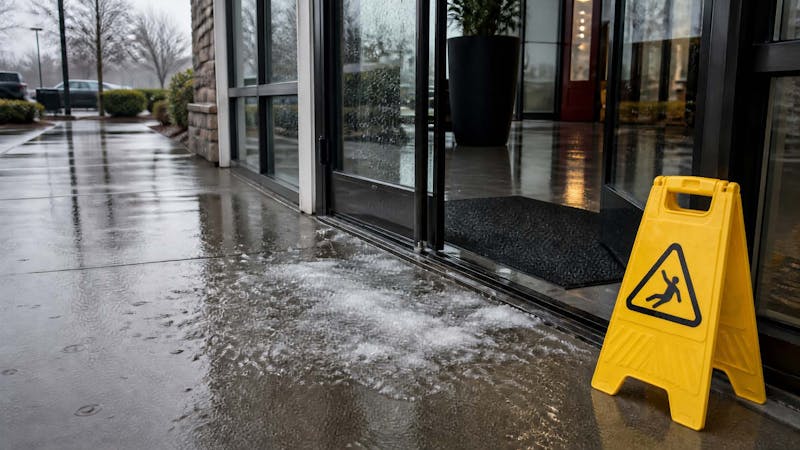
The Commons at Federal Way and the surrounding retail on S 320th Street generate the highest foot traffic in the city, and they concentrate the classic hazards. Customers cross a large open parking field, then enter through doors where hundreds of wet shoes deposit water onto hard flooring every hour.
The recurring failures are entrance matting that is too short to absorb the water people track in, matting that becomes saturated by midday and is never swapped out, wet-floor signs that go up after a fall rather than before, and parking lot drainage that sends meltwater across a pedestrian route where it refreezes overnight.
If you fell at a mall or big-box entrance, the inspection log and the matting maintenance schedule are the two documents that decide the case.
The Pacific Highway S corridor
The SR-99 commercial corridor running south from S 320th to S 348th is built around gas stations, quick-service restaurants, strip retail, and large surface parking lots. Fuel canopies drip. Asphalt aprons pitch toward walkways. Lighting on the older parcels is dim enough that black ice is genuinely invisible at 6 a.m. in January.
The corridor also carries a distinct hazard the malls do not: the transition zone where a private lot meets a public sidewalk. That seam raises the question of who owed you the duty, covered below.
Twin Lakes Village and Campus Drive SW
West Federal Way's commercial pockets along Campus Drive SW and 21st Avenue SW serve a heavy share of the city's older residents. Falls here more often involve sloped approaches, curb transitions, and parking lots that drain across the pedestrian path rather than away from it. Injuries skew more severe because the population skews older, which affects both the medical picture and the damages analysis.
Steel Lake and the S 312th commercial pockets
The commercial strip east of I-5 near Steel Lake mixes small retail and service businesses with limited on-site maintenance staff. Smaller operators are far less likely to have a written inspection routine or a winter-weather protocol, and the absence of any documented procedure is itself powerful evidence of unreasonable care.
Who is Responsible When You Fall on a Sidewalk
This question comes up constantly in Federal Way, and the answer surprises people.
Federal Way Revised Code Chapter 4.40 places a duty on the owner, lessee, or occupant of property abutting a street or public place to clear all snow and ice from the adjacent sidewalk, across its full width, within 24 hours of accumulation. If the ice is frozen too hard to remove without damaging the pavement, the code allows spreading sand or ashes during the removal window, with a full cleaning once conditions permit.
So the business next to the sidewalk has a code obligation. It is natural to assume that a violation of that obligation makes the business automatically liable to you. It does not work that way.
Washington draws a line between a municipal code duty owed to the city and a tort duty owed to an injured pedestrian. In Rivett v. City of Tacoma, the Washington Supreme Court addressed a Tacoma ordinance that attempted to shift sidewalk liability onto abutting property owners and held that a city cannot transfer its responsibility for sidewalk defects that way.
The practical consequences for your case:
- On a public sidewalk, the claim usually runs against the city, and that path has a hard procedural trap. Claims against a Washington municipality require a formal tort claim filing and a 60-day waiting period before suit. Miss it and the case is over regardless of merit.
- On private property, meaning the parking lot, the entryway, the walkway inside the property line, the claim runs against the owner or occupier under the Iwai and Mucsi standard.
- When the business created the hazard, for example by shoveling snow from its lot onto the public walk, or by directing downspout runoff across it, the business can be liable for the condition it made, wherever the ice ended up.
That last category is common and frequently missed. If a Federal Way business plowed its lot into a berm that melted across the sidewalk and refroze, the business caused the condition. Iwai's second question, whether the defendant caused the hazardous condition, applies directly.
Because the property line often decides which defendant you are suing and which deadline governs, photograph the fall location in a way that shows where you were relative to the curb, the parking stalls, and the building.
What to Do in the First 48 Hours
Weather evidence disappears faster than any other kind. Ice melts by noon. The puddle gets mopped. Surveillance systems in south King County retail commonly overwrite in 14 to 30 days.
Photograph the hazard before you leave, if you physically can. Capture the ice or water itself, a wide shot showing the surrounding area and the nearest door, the lighting conditions, any matting present or absent, and any warning sign or the empty spot where one should have been. Include something for scale.
Report it to a manager and get a written incident report. Ask for a copy before you go. If they will not provide one, note the time and the name of the person you told.
Do not accept the "it was just the weather" framing. You do not have to argue with the manager. Simply do not agree that nobody is responsible.
Get medical attention the same day. Adrenaline masks soft-tissue and head injuries routinely. A same-day record ties your injury to the fall and closes off the argument that something else caused it.
Save the shoes and the clothing you wore, unwashed. Tread condition is a standard defense attack, and the actual shoe answers it better than any testimony.
Write down the weather. Temperature, precipitation, and when it started. The official record for Federal Way comes from the SeaTac station, and it can be pulled later, but your contemporaneous note establishes what conditions were like at your exact location.
Send a preservation letter for the video. This one usually requires a lawyer, and it is time-critical. Once footage is overwritten, it is gone, and the strongest single piece of evidence in most of these cases goes with it.
What If You Were Partly At Fault
Almost every weather-fall claimant worries about this, and almost every one of them overestimates how much it matters.
Washington is a pure comparative fault state. Under RCW 4.22.005, contributory fault chargeable to the claimant diminishes the compensatory damage award proportionately but does not bar recovery. If a jury finds you 30 percent responsible for not watching your footing and values your damages at $100,000, you recover $70,000. You are not thrown out of court.
Compare that to states with a 50 percent bar, where the same finding at 51 percent produces nothing. Washington does not work that way, and insurance adjusters rarely volunteer the distinction. "You should have been more careful" is an argument about percentage, not an argument about whether you have a case.
Mucsi reinforces this. The Court held that a property owner owes a duty even for known risks when the owner should expect that people will fail to protect themselves against them.
The Deadline That Ends Cases
Under RCW 4.16.080(2), you generally have three years from the date of injury to file a personal injury lawsuit in Washington.
Three years sounds generous. It is not, for two reasons.
First, the clock does not stop while you negotiate. Adjusters can keep a friendly, unresolved conversation running for two and a half years, and nothing about that dialogue pauses the statute.
Second, if a government entity is a defendant, the timeline is much shorter in practice. Claims against a city, county, or the state require a formal tort claim filing followed by a 60-day waiting period before you may file suit. That is a separate procedural hurdle from the three-year statute, and blowing it is fatal to the claim.
Federal Way sits in King County, so a Federal Way premises case is filed in King County Superior Court, with the practical venue for most Federal Way litigants and witnesses being the Maleng Regional Justice Center in Kent.
What These Claims Are Worth
No honest lawyer quotes a number before reviewing the medical records. Recoverable categories in a Washington premises case include:
- Medical expenses, past and future, including surgery, imaging, and physical therapy
- Lost wages and lost earning capacity
- Pain and suffering
- Out-of-pocket costs tied to treatment, including mileage and assistive equipment
- Loss of consortium in serious cases
Weather falls tend to produce a specific injury profile. Ice removes your footing without warning, so people land hard and often backward: wrist and forearm fractures from bracing, hip fractures in older adults, and head injuries from an uncontrolled backward fall. Hip fractures in particular carry long recovery arcs and frequently involve permanent mobility loss, which changes the damages analysis substantially.
Past results do not guarantee future outcomes. Every case is different and must be evaluated on its own facts.
How Park Chenaur builds a Federal Way weather-fall case
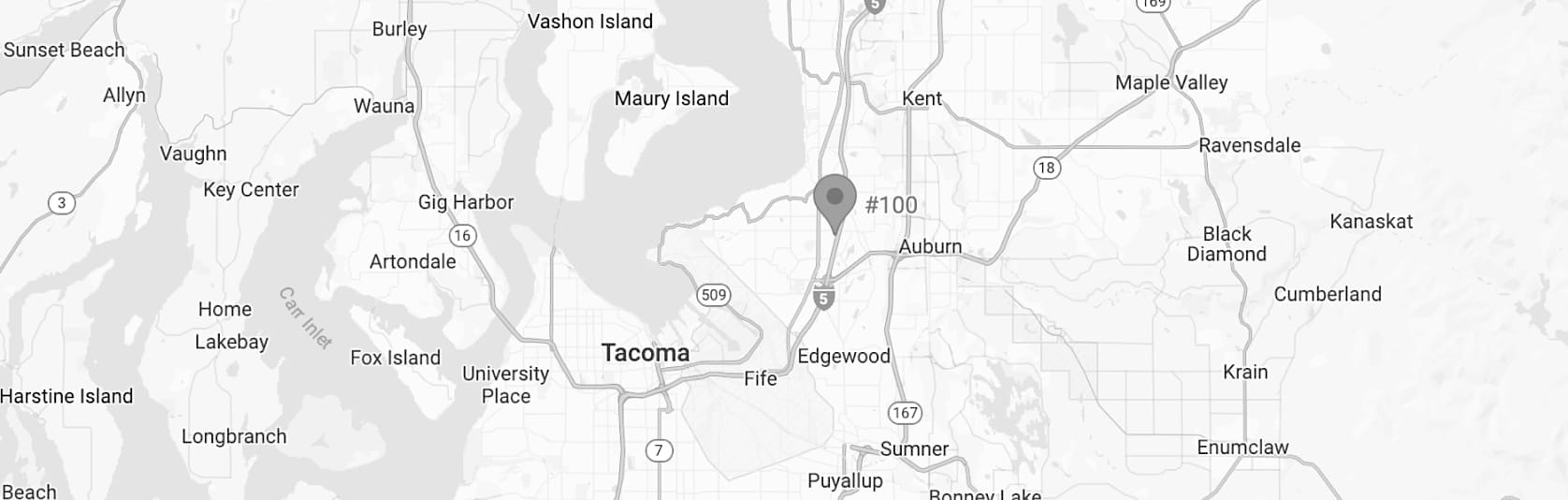
Our Federal Way office is at 2505 S 320th St, Suite 100, a few minutes from The Commons and the S 320th retail core where many of these falls happen. That proximity matters more than it sounds.
Weather evidence is perishable, and being able to get to a property quickly changes what we can preserve.
The investigation runs on a standard sequence:
- Preservation letter out immediately for surveillance video, incident reports, and maintenance records, before the retention window closes.
- Pull the official weather record for the date and time from the SeaTac station, establishing precipitation, temperature, and freeze-thaw cycling in the hours before your fall.
- Request the inspection log. Businesses with a written sweep schedule have to prove they followed it. Businesses without one have to explain why a property in a 156-precipitation-day climate had no winter protocol at all.
- Document the physical property, including drainage direction, lot slope, lighting levels, matting, and where meltwater travels.
- Identify every responsible party. Property owner, tenant, property management company, and the snow removal or landscaping contractor can all carry separate policies, and there is often more coverage available than the first adjuster mentions.
- Locate the prior incident history. A property with earlier falls at the same door has actual notice, and that reframes the entire case.
Frequently Asked Questions
Can I sue if I slipped on ice that formed naturally?
Yes. Washington rejected the natural accumulation rule in Iwai v. State, 129 Wn.2d 84 (1996). A property owner has a duty to control snow and ice accumulation and make passage reasonably safe. The question is not who put the ice there. It is whether the business took reasonable steps once it knew or should have known about the hazard.
The store had a wet floor sign out. Does that end my claim?
No. A warning sign is one factor, not a complete defense. The sign has to be placed where it actually warns someone approaching the hazard, and in some conditions a sign alone is not reasonable care when the hazard could have been cleaned up instead. A sign posted after your fall is not a defense at all.
How long do I have to file a Federal Way slip and fall case?
Three years from the date of injury under RCW 4.16.080(2). If a city, county, or the state is a defendant, you also must file a formal tort claim and wait 60 days before suing. Those deadlines run independently. Missing either can end an otherwise strong case.
What if I did not report the fall to the business that day?
You can still pursue a claim, though it makes proof harder. Same-day reporting creates a record that pins down date, time, and location. Without it, expect the insurer to argue the fall happened somewhere else. Witness names, photos, timestamped phone data, and same-day medical records can fill the gap.
Is the property owner responsible for the public sidewalk out front?
Usually not directly. Federal Way Revised Code 4.40 requires abutting owners to clear sidewalks within 24 hours, but Washington does not let a city convert that code duty into automatic tort liability to a pedestrian. If the business created the hazard, by plowing snow onto the walk or draining water across it, the business can be liable for the condition it caused.
I was looking at my phone when I fell. Do I still have a case?
Probably yes. Washington's pure comparative fault rule under RCW 4.22.005 reduces your recovery by your share of fault but does not eliminate it. Being distracted may cost you a percentage. It does not remove the property owner's underlying duty to maintain a reasonably safe surface.
What if the business plowed or shoveled but I still fell?
That can strengthen your claim rather than weaken it. In Iwai, the parking lot had been plowed but not sanded, and the court treated that incomplete effort as evidence supporting liability. A partial cleanup that leaves a slick surface behind can create a more dangerous condition than untouched snow.
How much is a Federal Way ice slip and fall case worth?
It depends on injury severity, medical costs, lost income, and the strength of the liability evidence. Weather falls often produce wrist fractures, hip fractures, and head injuries, which carry higher medical and long-term-care costs than typical soft-tissue claims. No lawyer can value your case responsibly before reviewing the records.
Does my own health insurance affect what I can recover?
No. Washington's collateral source rule generally prevents a defendant from reducing what it owes because your health insurer paid your bills. Your insurer may assert a lien or subrogation claim against your settlement, which is a separate issue your attorney negotiates as part of resolving the case.
How long does the business keep the surveillance video?
Often only 14 to 30 days, and many systems overwrite automatically. This is the most time-sensitive part of any weather-fall case. A preservation letter needs to go out quickly, which is the main reason to talk to a lawyer within days rather than months.
Can I bring a claim if I fell at my apartment complex rather than a business?
Yes, though the legal framework differs. Residential landlord claims run through the Washington Residential Landlord-Tenant Act and the common-area duty from Mucsi v. Graoch Associates. The analysis in this article addresses commercial and business property.
What does it cost to hire a premises liability lawyer?
Park Chenaur handles these cases on contingency. There is no fee unless we recover for you, and the initial consultation is free. You should never have to pay up front to find out whether you have a claim.
The Bottom Line
The weather did not injure you. A property owner's decision about how to handle predictable weather injured you.
Washington law has recognized that distinction since 1996. Federal Way sees measurable precipitation 156 days a year, and no business operating here gets to treat a wet or icy surface as an act of God it could not have seen coming. The evidence that proves it, the video, the inspection log, the maintenance record, is sitting on someone else's server right now, and it does not stay there long.
If you were hurt in a slip and fall on ice, snow, or water at a Federal Way business, the premises liability attorneys at Park Chenaur Injury Lawyers can evaluate the property's maintenance history, preserve the evidence before it disappears, and determine whether you have a claim.